The ESP32-S3 development board with a 4.3-inch IPS display is a powerful single-board platform for hobbyists and engineers who need a screen, wireless connectivity, and serious compute in one compact package. It pairs an ESP32-S3 chip with a large touch-capable display, making it ideal for dashboards, smart-home control panels, and interactive IoT devices.
We build and sell this board at MadeInCN Shop, so this guide explains the hardware, what it can do, and how to get started with Arduino, MicroPython, or ESP-IDF.
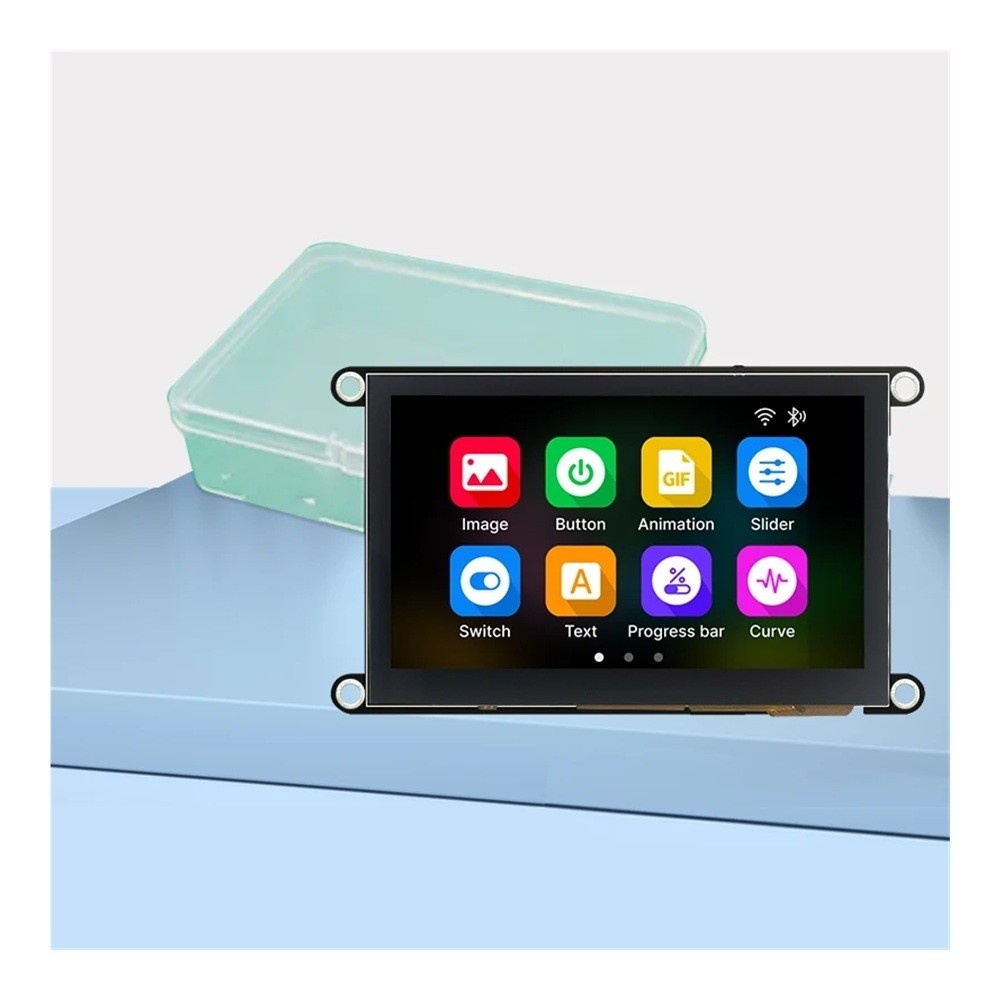
What’s on the Board
Based on the product specifications, the board is built around the ESP32-S3 microcontroller, a dual-core Xtensa LX7 chip with Wi-Fi and Bluetooth connectivity. It ships with a 4.3-inch IPS display at 480×272 resolution, and is equipped with 8 MB PSRAM and 4 MB flash, giving you ample memory for rich UIs and complex projects. An integrated IPEX antenna provides for external antenna options when you need better range.
| Spec | Detail |
|---|---|
| MCU | ESP32-S3 (dual-core Xtensa LX7) |
| Display | 4.3-inch IPS, 480×272 resolution |
| PSRAM | 8 MB |
| Flash | 4 MB |
| Connectivity | Wi-Fi (2.4 GHz) and Bluetooth / BLE |
| Antenna | On-board IPEX connector for an external antenna |
| Programming | Arduino, MicroPython, ESP-IDF |
What You Can Build
The combination of a large display, Wi-Fi, and plenty of memory opens up a wide range of projects:
- IoT dashboards and home automation control panels that show sensor data and device states.
- Smart displays for weather, calendars, or media playback controls.
- Retro gaming and handheld consoles thanks to the 480×272 screen and ample RAM.
- Interactive prototypes and HMI (human-machine interface) panels for products and kiosks.
- Networked sensors and data loggers that push readings to a server or cloud.
Which Framework Should You Use?
- Arduino is the fastest way to get started, with the largest library ecosystem and the most tutorials.
- MicroPython is ideal if you prefer a Python workflow and rapid iteration, though it consumes more of the device’s memory.
- ESP-IDF (Espressif’s native framework) gives the most control, performance, and access to low-level features, and is best for production or advanced projects.
Pros and Cons
Pros
- Large, bright IPS display makes rich user interfaces easy.
- 8 MB PSRAM and 4 MB flash support complex, memory-hungry applications.
- Built-in Wi-Fi and Bluetooth for easy connectivity.
- Fully supported by Arduino, MicroPython, and ESP-IDF.
Cons
- The large display draws more power, so battery-powered projects need power management.
- More complex than a bare ESP32 module, so it suits projects that genuinely need a screen.
- Touch and display libraries may require additional wiring or calibration depending on the exact panel.
Getting Started Tips
- Start with a known-good display or touch driver library that matches your panel to save time.
- Use an appropriate external antenna via the IPEX connector if you place the board in an enclosure.
- Power the board from a stable 5 V supply, especially when drawing current for the display.
- Keep your ESP-IDF or Arduino core up to date for the best Wi-Fi stability on the ESP32-S3.
FAQ
Can I program the ESP32-S3 board with Arduino IDE?
Yes. The ESP32-S3 is fully supported by the Arduino IDE via the Espressif board package, and the board works with display libraries in the Arduino ecosystem.
Does the board support MicroPython?
Yes. You can flash a MicroPython firmware for the ESP32-S3 and run Python scripts, although memory-is-hungry UIs should be optimised.
Can I use an external antenna?
Yes. The board includes an IPEX connector, so you can attach an external antenna to improve Wi-Fi range when the board is housed in metal or a thick enclosure.
Is the ESP32-S3 good for WiFi projects?
Yes. The ESP32-S3 has integrated 2.4 GHz Wi-Fi and Bluetooth, making it well suited to IoT devices that need to connect to a network or cloud.
Verdict
The ESP32-S3 board with a 4.3-inch IPS display is a versatile and capable platform for anyone who wants to build a screen-plus-connectivity device. With strong Arduino, MicroPython, and ESP-IDF support and generous memory, it is a great choice for dashboards, smart displays, and interactive IoT projects.
Ready to build? Get the board and start your project at MadeInCN Shop.
Leave a Reply